Patente B at your fingertips: 10 topics behind 15 questions
Preparing for Patente B in English? Start with patterns you can understand. We analysed 300 questions from 10 distinct exam papers: the same ten topic groups accounted for 15 of the 30 questions in every paper. Here is how to turn that finding into focused revision, with recurring figures and the Italian words that change an answer.
DriveLingua ·
- distinct exam papers
- 10
- questions analysed
- 300
- questions in our ten-topic group, per paper
- 15 / 30
The 10 recurring topics: what the papers actually showed
The first five groups each appeared twice per paper; the next five each appeared once. Together they covered 150 of the 300 question slots. These are broad topic groups, not ten individual questions or ten pictures. Their recurrence in this small sample does not predict your next exam or guarantee 15 correct answers.
| Topic group | Across 10 papers | In each paper |
|---|---|---|
| Following distance | 20 | 2 |
| Road position, lane changes and turns | 20 | 2 |
| Fitness to drive, alcohol/drugs and first aid | 20 | 2 |
| Breakdowns, warning triangles and motorways | 20 | 2 |
| Priority signs | 20 | 2 |
| Warning signs | 10 | 1 |
| Prohibition signs | 10 | 1 |
| Mandatory signs | 10 | 1 |
| Road markings | 10 | 1 |
| Traffic lights and police signals | 10 | 1 |
Learn the rule once, recognise different questions
Following distance is about having room to avoid the vehicle ahead. Read what the statement says it depends on: speed, grip and attention matter; the width of the vehicle ahead is a different idea. Keep distanza di sicurezza (following distance), spazio di reazione (reaction distance) and spazio di frenatura (braking distance) separate.
For lane changes and turns, identify who is moving, which lane they occupy and what signal is required. For motorway and breakdown questions, identify the road type and the exact situation before deciding. The same vocabulary can appear in a true statement and a false one.
For fitness-to-drive and first-aid revision, read the complete claim rather than memorising a keyword. In the visual groups, first name the sign, marking or signal, then check whether the sentence describes its real meaning. You need the other topics too: the remaining 15 questions in each sample paper came from outside this focus group.
Repeated figure: give way to oncoming traffic
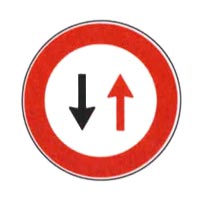
Seen 4 times across the 10 distinct papers.
The red circle with opposite arrows requires you to give way at a narrow passage. It is different from the blue square that gives you priority. Look at the border, background and arrow colours before reading the claim; the same picture appeared with different statements in these papers.
Remember: dare precedenza = give way; senso opposto = opposite direction; strettoia = narrow passage.
Repeated figure: the 80 km/h maximum-speed sign
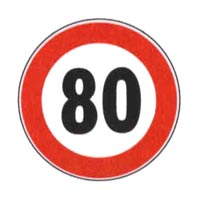
Seen 3 times across the 10 distinct papers.
A red-bordered 80 sign sets a maximum, not a minimum. A lower speed may be appropriate; the limit still applies while overtaking. Compare it with a blue minimum-speed sign so the number alone does not decide your answer.
Remember: limite massimo = maximum limit; inferiore = lower; superiore = higher.
Repeated figure: ordinary vehicle traffic lights
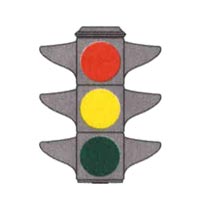
Seen 3 times across the 10 distinct papers.
Identify the kind of signal first: these lights regulate vehicles. A red light requires a stop; adding 'with maximum caution' does not make passing it allowed. Learn the separate rules for green, steady amber, flashing amber and a signal that is switched off.
Remember: accesa = on; spenta = off; lampeggiante = flashing; arrestarsi = stop.
Repeated figure: a mobile roadworks warning
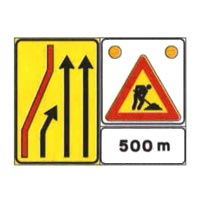
Seen 3 times across the 10 distinct papers.
Read this as a roadworks warning and lane-direction instruction. It can be mounted on a vehicle to warn of roadworks. A directional arrow here does not mean that the left side is a parking bay. Look at the whole panel, not only its arrow.
Remember: cantiere = roadworks; corsia = lane; piazzola di sosta = stopping/parking bay.
Repeated figure: the give-way triangle
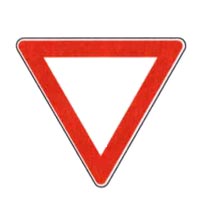
Seen 3 times across the 10 distinct papers.
This inverted triangle requires you to give way to traffic on the road you are joining. Slow down and stop if necessary. Contrast it with the octagonal STOP sign, which requires a stop. Questions may ask about the sign family or an advance warning as well as the action at the junction.
Remember: fermarsi = stop; dare precedenza = give way; preavviso = advance warning.
Eight statements that appeared twice: learn the correction
Each of these exact Italian statements occurred in two distinct papers. Below we paraphrase the claim and teach the useful rule; these are sample counts, not a prediction of the next question.
| Claim in the repeated question | Answer and useful correction |
|---|---|
| Tyre pressure does not affect grip. | FALSO: tyre pressure affects grip. |
| Following distance prevents a head-on collision. | FALSO: it helps avoid rear-ending the vehicle ahead. |
| When being overtaken with oncoming traffic, reducing speed is advisable. | VERO: help the overtaking manoeuvre finish safely. |
| Dipped headlights on motorways are optional in clear visibility. | FALSO: the statement wrongly makes their use optional. |
| Looking for radio controls can distract a driver. | VERO: attention can leave the road even briefly. |
| Unauthorised vehicles may not park in a restricted-traffic zone. | VERO: recognise sosta and non autorizzati. |
| Hashish or marijuana can impair driving ability. | VERO: recognise può compromettere = can impair. |
| Following distance is determined by the width of the vehicle ahead. | FALSO: width is not the deciding factor claimed here. |
A 15-minute revision routine you can repeat
Minutes 1–3: choose one topic in the 504-topic course. Read its explanation in English and say the rule in your own words. Urdu learners can switch to Urdu; keep the Italian terms visible.
Minutes 4–8: study one figure and compare it with a similar-looking sign. Ask what changes: the colour, shape, arrow, number or small panel? Explain why the two signs lead to different answers.
Minutes 9–13: answer fresh Italian questions. After a mistake, read why your answer failed and identify the word that changed the claim. Non, solo and sempre deserve attention, but none is an automatic VERO/FALSO shortcut.
Final 2 minutes: recall the rule and three Italian words without looking. Return to your mistakes later and practise full exams too. The standard Patente B theory format is 30 true/false statements in 20 minutes, with no more than 3 errors to pass; English and Urdu here support your study of the Italian questions.
How we counted: a small, transparent exam-paper sample
We received 11 PDF files, removed one duplicate exam paper and analysed 10 distinct 30-question papers. One scanned paper was read with OCR and checked visually. Statements were matched against our committed 7,020-statement official list; when identical wording accompanied different figures, we checked the figure before assigning a topic. We counted question appearances, not candidates' mistakes. The eight repeated statements appeared twice each; figures were counted separately, so one figure can accompany several different questions.
This is a reader-supplied convenience sample, not a random national survey. Study the full syllabus. The downloadable evidence contains only anonymous question IDs and counts; the original exam sheets and personal details are not published.
Questions
Will learning these topics guarantee 15 correct answers?
No. They covered 15 question slots in each paper in this sample. Correct answers require understanding the rules and the complete Italian statements; your exam can differ.
Can I study Patente B in English or Urdu?
Yes. DriveLingua explains the rules and vocabulary in English and Urdu while keeping the quiz statements in Italian. Use your language to understand the rule, then practise recognising it in Italian.
Which figure repeated most in these papers?
The red circular give-way-to-oncoming-traffic sign appeared four times across the ten distinct papers, attached to different statements. That is a sample count, not a forecast.
Are repeated topics the same as repeated questions?
No. A topic can contain many different statements and images. We found eight exact statements appearing twice each, whereas the topic counts include different questions within the same subject.
Independent learning tool, not affiliated with the Italian Ministry of Transport. Portale dell'Automobilista